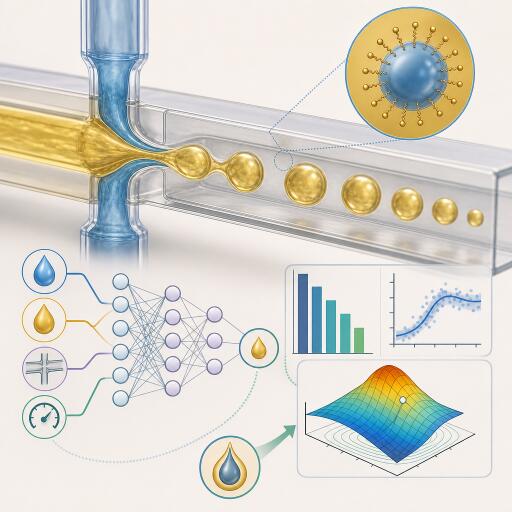

Interpretable machine learning for predicting and optimizing water-in-oil droplet formation in minichannel flow
Creating water-in-oil droplets inside minichannels is a crucial step in many chemical, biomedical, and process-engineering applications. The challenge is not simply to make droplets, but to produce them with the right shape and size: ideally spherical and highly uniform. A new study shows how interpretable machine learning can help solve that problem by predicting droplet behavior with high accuracy and identifying the operating conditions that lead to better results.
The research combines computational fluid dynamics (CFD), machine learning, interpretability tools, and optimization algorithms into a single workflow. Rather than relying only on trial-and-error experiments or expensive simulations, the authors built predictive models that estimate two key droplet properties: sphericity and diameter.
Why droplet quality matters
In two-phase minichannel flows, droplet characteristics strongly affect downstream performance. Droplets that are too large, too irregular, or inconsistent in size can reduce process efficiency and limit product quality. That makes accurate prediction especially valuable for engineers designing microfluidic and multiphase flow systems.
To tackle this, the researchers used data generated from 198 CFD simulations. These simulations captured how droplet formation changes under different flow and material conditions, creating a dataset large enough to train and test several machine learning regressors.
Five machine learning models put to the test
The study evaluated five popular regression algorithms:
- LightGBM
- AdaBoost
- Random Forest
- XGBoost
- Support Vector Regression
Each model was trained to predict droplet sphericity and droplet diameter from the CFD-derived input variables. The goal was not just to find a usable predictor, but to identify the most accurate and robust model for this fluid dynamics problem.
Among all candidates, XGBoost emerged as the top performer. It achieved a coefficient of determination of 0.978 for sphericity prediction and 0.986 for droplet diameter prediction. Those scores indicate an excellent fit between the model outputs and the simulation data, suggesting that the algorithm captures the main nonlinear relationships governing droplet formation.
Interpretability matters too
High accuracy alone is not enough, especially in engineering applications where understanding the drivers behind a prediction is just as important as the prediction itself. To address this, the researchers used SHAP analysis, a method that explains how individual variables contribute to model outputs.
The SHAP results revealed that viscosity and density were the most influential parameters affecting both droplet sphericity and diameter. That finding is important because it gives process engineers a clearer view of which levers matter most when tuning a system. Instead of treating the model as a black box, the study shows how explainable AI can expose the physical variables that dominate behavior in multiphase flow.
Checking reliability and applicability
Because the models were trained on simulation data, the authors also assessed whether the CFD-generated dataset was reliable and whether the machine learning models were being used within a valid operating range. For this, they applied the leverage approach, a standard technique for evaluating the applicability domain of predictive models.
The results were encouraging. Only 2.2% of the droplet diameter data and 1.5% of the sphericity data fell outside the applicability domain. In practical terms, that means the overwhelming majority of predictions were made within a space where the models can be considered dependable.
From prediction to optimization
The final step moved beyond prediction and into design. The researchers used the NSGA-II multi-objective optimization algorithm to find operating conditions that produce more desirable droplet characteristics. This is particularly useful because droplet engineering often involves balancing competing goals, such as maximizing sphericity while controlling diameter.
By coupling machine learning with optimization, the framework can quickly search for operating windows that would be difficult and time-consuming to identify manually. That makes the approach attractive for process development, where speed and precision are increasingly important.
Why this study stands out
What makes this work notable is its combination of accuracy, interpretability, and optimization. Many machine learning studies stop at prediction. Here, the authors went further by explaining the model’s decisions and turning those insights into practical operating guidance.
The broader implication is clear: data-driven methods are becoming powerful tools for fluid mechanics and microfluidic engineering. When paired with high-quality simulation data and interpretable techniques like SHAP, algorithms such as XGBoost can accelerate system design without sacrificing scientific insight.
The takeaway
This study demonstrates that interpretable machine learning can successfully predict and optimize water-in-oil droplet formation in minichannel flows. With strong performance from XGBoost, clear identification of viscosity and density as dominant factors, and successful multi-objective optimization through NSGA-II, the proposed framework offers a practical path toward smarter droplet design.
For industries and researchers working with two-phase flow systems, that could mean fewer costly experiments, faster process tuning, and better control over droplet quality.