
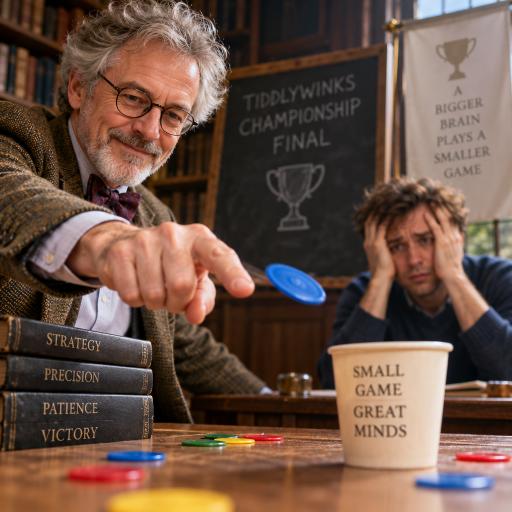
Can he flick it? Yes he can – professor sees off tiddlywinks title challenger
A Cambridge professor has successfully defended his world tiddlywinks crown after overcoming an experienced American rival in a tense seven-hour contest.
Patrick Barrie, 61, defeated Dave “The Dragon” Lockwood by 26 points to 23 at the Castle Inn in Cambridge. The closely fought encounter tested both players’ precision, tactical judgment and composure.
Tiddlywinks challenges competitors to launch small plastic counters into a cup by pressing down on them with a larger disc. Although the basic action is easy to understand, high-level play involves careful positioning, defensive moves and calculated risks.
The game dates back to the Victorian era, while its modern competitive form developed among Cambridge students during the 1950s.
Barrie, who works in Cambridge University’s Department of Chemical Engineering and Biotechnology, compared the championship format to a boxing title defence. Rather than entering a conventional knockout bracket, the reigning world champion faces an eligible challenger who has earned the opportunity through national competition.
<>
Lockwood, who lives near Washington DC, brought years of experience to the table and pushed the champion throughout the match. Barrie ultimately retained the trophy, but admitted that being considered the favourite created its own kind of pressure.
The final result brought a combination of satisfaction and relief. Barrie knew his long-time rival was capable of taking control if given the chance, forcing him to remain focused for the full duration of the contest.
At elite level, tiddlywinks blends dexterity with strategy. Players can learn the fundamental shots within months of regular practice, but mastering when to attempt them takes considerably longer. Competitors must read the table, anticipate possible responses and keep their nerves under control.
Harley Jones, chairman of the English Tiddlywinks Association, officiated the championship. He described the game as being similar to chess, except that even a well-planned move can fail because of imperfect execution.
Only English and American national singles champions can secure the right to challenge for the world title. The competitive scene remains small, with roughly 120 players appearing in the global rankings after participating in tournaments over the previous year.
Despite that modest player base, the standard at the top is demanding. Training, repetition and tactical study can make a substantial difference, while observing championship matches offers other competitors an opportunity to improve their own decision-making.
Barrie’s latest victory will not leave him without another test for long. A future title match is already being planned against reigning British champion Tim Hunt, who finished ahead of Barrie in the previous domestic championship.
The pair are expected to discuss the details of the next World Singles Tiddlywinks Championship, with the contest potentially taking place in the spring.