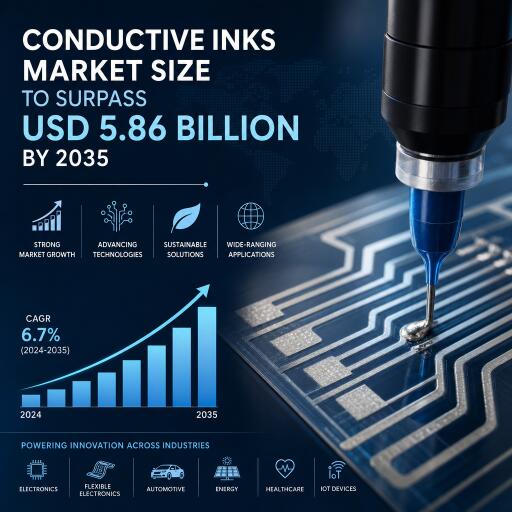

Conductive Inks Market Size to Surpass USD 5.86 Billion by 2035 | SNS Insider – Business Upturn
Conductive inks are stepping into the mainstream as the backbone of printed and flexible electronics, with the global market projected to climb from USD 3.80 billion in 2025 to USD 5.86 billion by 2035, a compound annual growth rate of 4.38%. Momentum is coming from the rapid spread of IoT hardware, wearables, smart packaging, next‑gen displays, EV components, and solar technologies—areas where thin, lightweight, and highly customizable circuitry is essential.
What’s powering the surge
As devices shrink and functionality grows, manufacturers are trading traditional wiring and rigid boards for printed circuits that are lighter, faster to produce, and more cost‑effective at scale. Conductive inks enable high‑precision features—think antennas, sensors, and interconnects—directly on flexible substrates used in phones, fitness trackers, medical patches, and even AR/VR peripherals. The drive for portability and energy efficiency across consumer tech and automotive electronics continues to elevate demand. Meanwhile, the healthcare sector is embracing biosensors and diagnostic wearables, and the energy industry is integrating printed elements into solar cells and power management systems.
Key numbers at a glance
- Global market: USD 3.80 billion (2025) to USD 5.86 billion (2035), CAGR 4.38%.
- U.S. market: USD 1.03 billion (2025) to about USD 1.49 billion (2035), CAGR 3.06%.
- The U.S. remains a hub for advanced printed electronics thanks to strong ecosystems in semiconductors, consumer tech, automotive electronics, and medical devices.
Where conductive inks are used most
- Printed electronics led revenue in 2025 with roughly 38.50% share, reflecting widespread use in flexible circuits, RFID, sensors, and smart consumer products.
- Solar cells are expected to post the fastest growth through 2035 as renewable energy capacity accelerates and module makers adopt printed conductors for efficiency gains.
- By device type, printed circuit boards (PCBs) held about 33.90% in 2025, supported by consumer electronics, automotive, and industrial demand.
- Biosensors are set for the highest CAGR through 2035 as healthcare shifts toward real‑time monitoring and noninvasive diagnostics.
- Among end uses, consumer electronics captured around 34.80% in 2025 on strong shipments of smartphones, wearables, and smart home devices.
- Healthcare and medical devices are projected to grow the fastest, boosted by diagnostic patches, glucose monitors, and hospital‑grade sensing solutions.
Materials: silver leads, carbon and graphene gain ground
- Silver‑based inks accounted for about 42.80% of the market in 2025, favored for superior conductivity and stable performance in demanding environments.
- Carbon/graphene formulations are set to expand at the highest rate through 2035, offering a compelling mix of cost efficiency, flexibility, and sustainability.
Printing tech: screen today, inkjet tomorrow
- Screen printing held the top share at approximately 44.20% in 2025, delivering high throughput and attractive economics for mass production.
- Inkjet printing is on track for the fastest growth, prized for precision patterning, digital flexibility, and minimal material waste—ideal for prototyping and high‑mix, low‑volume runs.
Regional outlook
- North America led with about 34.60% share in 2025, supported by mature supply chains and robust demand across electronics, automotive, and healthcare industries.
- Asia‑Pacific is poised for the highest CAGR of 5.85% through 2035, propelled by rapid expansion in consumer electronics manufacturing, flexible displays, and solar PV deployments.
Why it matters for immersive tech
For gaming and immersive platforms, the march toward lighter, more comfortable wearables depends on thin, flexible circuitry that preserves performance without bulk. Conductive inks enable conformal antennas for low‑latency wireless, skin‑friendly biosensors for adaptive gameplay and fitness tracking, and compact interconnects for AR/VR headsets and haptic peripherals. As printing techniques mature, expect faster product cycles and more modular designs, lowering barriers to innovation across XR accessories and next‑gen controllers.
Recent moves and momentum
- 2026: Adoption broadened across North America and Asia‑Pacific as demand intensified for flexible electronics, IoT nodes, and miniaturized printed circuits.
- 2025: Major suppliers expanded portfolios of silver, copper, and graphene inks to serve advanced printed electronics, including antennas, sensors, and high‑density interconnects.
What to watch next
- Hybrid material stacks pairing silver with carbon/graphene to optimize cost and performance.
- Greater use of roll‑to‑roll manufacturing for scalable, low‑waste production.
- Integration of conductive inks in EV battery management, in‑car sensors, and smart surfaces.
- Broader healthcare deployments of patch‑based diagnostics and continuous monitoring systems.
From smart labels to solar modules and XR wearables, conductive inks are quietly rewiring how electronics are made. With the market on track to top USD 5.86 billion by 2035, the next decade will reward materials innovation, efficient printing processes, and designs that push portability without sacrificing performance.