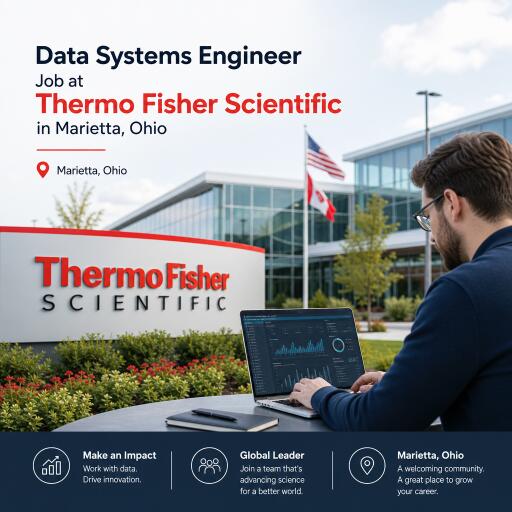

Data Systems Engineer Job at Thermo Fisher Scientific in Marietta Ohio – Archyde
Thermo Fisher Scientific is hiring a Data Systems Engineer to support its research and manufacturing footprint in Marietta, Ohio. The role centers on building the digital backbone that powers the design, validation, and production of temperature-controlled lab equipment and other scientific instruments.
Marietta’s Role in High-Stakes Lab Hardware
Marietta functions as a pivotal site for developing and producing cold-storage systems, environmental chambers, and related lab infrastructure. With production lines and R&D under the same regional umbrella, the location is primed for rapid feedback cycles—turning engineering insights from data into tangible hardware improvements. The new engineering position underscores a broader shift toward data-rich, highly automated operations.
From Sensors to Strategy: What This Engineer Builds
Modern lab devices stream a constant flow of telemetry and quality metrics. This job is about capturing that flow—without losing fidelity—then shaping it into intelligence that accelerates product decisions and ensures regulatory-grade traceability. Think edge-to-cloud pipelines that never blink, time-aligned datasets for validation, and dashboards that turn raw signals into answers.
- Design and maintain data pipelines for high-frequency device telemetry and production metrics.
- Integrate instrumentation data with enterprise systems, including manufacturing and quality platforms.
- Steward databases and storage strategies to ensure integrity, performance, and scalability.
- Partner with mechanical, electrical, firmware, and test teams to translate bench data into engineering actions.
- Support security, auditing, and compliance requirements typical of regulated lab equipment environments.
The Technical Demands of Connected Labs
Industrial R&D has moved beyond isolated data logging. Networked instruments now operate within IoT-style architectures where uptime, precision, and security are non-negotiable. Systems must ingest spiky, high-volume streams, enforce strong access controls, and keep data lineage auditable from sensor to cloud. Reliability meets rigor: a single blind spot in the pipeline can ripple through validation, quality checks, and ultimately, product performance.
On the ground, that translates to resilient services, observability across the stack, and careful schema design for both time-series and relational workloads. It also requires thoughtful orchestration—containerized services, automated tests, CI/CD—so changes can ship quickly without risking compliance or stability. In short, this engineer is the connective tissue between lab benches and executive dashboards.
Why Southeastern Ohio Attracts Builder-Minded Engineers
Hiring specialized data talent outside major tech corridors comes with trade-offs and advantages. While big-city hubs attract large software cohorts, Marietta offers a front-row seat to the full hardware lifecycle. Code and queries don’t live in abstraction here—they’re visibly tied to instrument performance on the floor and in test chambers. For engineers who enjoy seeing their systems influence real-world devices, the feedback loop is immediate and satisfying.
The competition for talent spans advanced manufacturing and industrial automation across the region. Yet the opportunity to work at the intersection of data systems and life-science hardware—where reliability directly influences research outcomes—adds a compelling dimension for professionals seeking impact.
Where Industrial Data Is Heading
Through 2026 and beyond, the pace of automation will demand deeper resilience, stronger security postures, and more seamless interoperability between edge devices and cloud analytics. Expect heavier use of streaming frameworks, digital twins for environmental testing, and AI-driven anomaly detection to anticipate failures before they compromise lab results or shipments.
The biggest hurdles for traditional plants? Modernizing legacy systems without disrupting production; maintaining airtight data governance; unifying siloed datasets; and upskilling teams to run secure, always-on pipelines. Facilities like Marietta are on the frontlines of that transformation—bridging decades of manufacturing expertise with software-first practices.
For engineers, this role offers a rare vantage point: the chance to architect data systems that don’t just inform business decisions, but directly elevate the reliability of scientific instruments used worldwide. If you thrive at the junction of code, compliance, and physical hardware, this is the kind of build space where every query and message queue can move the needle.
What do you see as the toughest challenge in scaling industrial data stacks—retrofitting legacy equipment, enforcing end-to-end observability, or meeting compliance without throttling innovation?