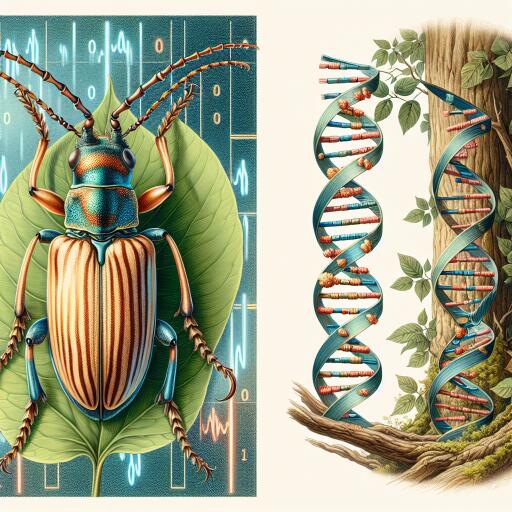

First reference genome for the family Disteniidae (Coleoptera: Chrysomeloidea), the sister lineage to all longhorned beetles (Cerambycidae) – Scientific Data
A research team has unveiled the first chromosome-level reference genome for the beetle family Disteniidae—an evolutionarily pivotal but historically overlooked lineage that sits as the closest living sister to the longhorned beetles (Cerambycidae). The draft, shared ahead of final editorial polish, provides early access to findings that could reshape how scientists study the origins of wood-feeding behaviors and the spread of plant cell wall–degrading enzymes across the superfamily Chrysomeloidea. As an unedited manuscript, details may change before publication and standard legal disclaimers apply.
Why this genome matters
Disteniidae has long been a missing piece in the genomic puzzle of Chrysomeloidea, a hyper-diverse, plant-feeding beetle superfamily. By producing a high-quality reference for the East Asian species Distenia gracilis (Blessig), researchers have created a critical anchor for comparative genomics across the group—most notably with its sister lineage, the longhorned beetles. This opens the door to answering long-standing questions about how wood-feeding evolved and how beetles acquired the genetic tools—potentially via horizontal gene transfer—to break down tough plant materials like cellulose and lignin.
How they built it
The team used a modern, multimodal sequencing strategy to maximize assembly quality and gene discovery:
- PacBio HiFi long reads for highly accurate, long-range sequence information
- Pore-C chromatin conformation capture to scaffold sequences into chromosome-scale assemblies
- Illumina RNA sequencing to guide gene prediction and functional annotation
By the numbers
- Genome size: 1.89 Gbp—among the largest reported for cerambycid-related beetles
- Assembly contiguity: Scaffold N50 of 203.5 Mbp
- Chromosome anchoring: 97.1% of the assembly placed on 10 chromosome-scale scaffolds
- Sex chromosome: Synteny analysis identifies chromosome 10 as the X chromosome
- Genome composition: 66.8% repetitive elements
- Gene predictions: 77,131 protein-coding genes
- Functional annotations: 33,643 genes annotated
A conserved X chromosome across beetles
One of the headline findings is the identification of chromosome 10 as the X chromosome. Synteny—conserved gene order—across related beetles supports the idea that the X chromosome is deeply conserved within Coleoptera. That kind of cross-species chromosome stability helps researchers trace evolutionary events and link structural features to shared biology across vast timescales.
Repetitive DNA dominates
With 66.8% of the genome composed of repetitive elements, D. gracilis underscores how dynamic and repeat-rich beetle genomes can be. Repetitive DNA, including transposable elements, often plays a major role in genome size inflation and can influence gene regulation, adaptation, and genome evolution. Accounting for such a high repeat load is a key reason the use of long reads and chromatin conformation data was essential for achieving chromosome-level assembly quality.
A platform for decoding wood-feeding and enzyme evolution
Chrysomeloidea includes many wood-feeding lineages, and past research has suggested that some plant cell wall–degrading enzymes in these beetles were acquired horizontally from microbes. The new Disteniidae reference genome provides a phylogenetic outgroup and a clean baseline for testing when and how these genes appeared, diversified, or were lost. With over 77,000 predicted protein-coding genes and tens of thousands functionally annotated, researchers can now more precisely map gene families associated with lignocellulose digestion, symbiosis, and dietary specialization.
What to watch next
Expect follow-up studies to:
- Compare gene families for plant cell wall degradation across Disteniidae and Cerambycidae
- Interrogate the evolutionary timing and mechanisms of horizontal gene transfer
- Refine chromosome evolution models in Coleoptera using the conserved X as a reference point
- Explore the regulatory roles of repetitive elements in shaping beetle adaptation and speciation
The bottom line
This first reference genome for Disteniidae does more than fill a taxonomic gap—it equips entomologists and evolutionary biologists with a powerful comparative framework. By delivering a large, repeat-rich, chromosome-scale assembly with extensive gene predictions and annotations, the study lays groundwork for dissecting the genetic foundations of wood-feeding and the remarkable evolutionary paths that have enabled beetles to conquer plant-based diets. As the manuscript proceeds through final editing, its early insights already mark a significant leap forward for Chrysomeloidea genomics and beetle evolutionary research.