

Typewriter takeover: Revival part of national trend toward old-school testing methods to prevent AI use
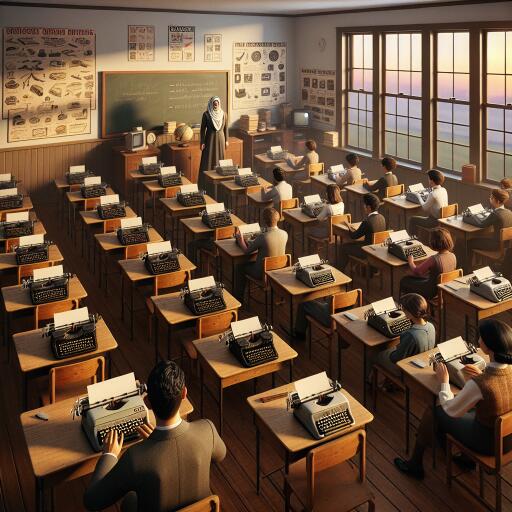
The soundtrack is unmistakably mid-century: keys clacking, a carriage sliding, and that crisp bell at the end of a line. But this isn’t a period film set—it’s a modern classroom where students are discovering what it means to write without the web at their fingertips.
Once each semester, Grit Matthias Phelps, a German language instructor at Cornell University, asks her students to compose the old-fashioned way: on manual typewriters, with no screens, no online dictionaries, no spellcheck, and no delete key. The exercise, which she introduced in spring 2023, is designed to strip writing down to thought, recall, and form—without the digital scaffolding that now hovers over nearly every academic task.
Phelps began the practice as generative AI and online translation tools grew capable of producing fluent, near-perfect text that can mask how well a student actually understands a language. “What’s the point of me reading it if it’s already correct anyway, and you didn’t write it yourself? Could you produce it without your computer?” Phelps said.
Analog as antidote
Phelps’s typewriter day captures a broader academic recalibration. Across campuses and classrooms, instructors are experimenting with low-tech assessments to verify authorship, slow students down, and make thinking visible again. In-class essays, oral defenses, handwritten blue books, whiteboard problem-solving, and closed-network labs are all reappearing as pragmatic counterweights to AI-aided writing and translation.
Typewriters represent the most tactile version of this trend. They impose productive constraints: every keystroke is consequential, revisions require deliberation, and vocabulary must come from memory rather than a search bar. For language learning in particular, the medium matters—the friction of composition encourages students to form sentences they can actually explain, not just reproduce.
Why manual matters
- Authenticity of authorship: In-room, on-paper (or on-plate) work reduces the ambiguity around who actually wrote the text.
- Cognitive load in the right places: Without tabs full of tools, students focus on syntax, structure, and idea flow.
- Transparent mistakes: Cross-outs and rephrasing reveal thought processes, giving instructors richer feedback points.
- Time-boxed rigor: The finite pace of typing and the absence of instant fixes reward preparation and clarity over last-minute polish.
Not nostalgia—assessment design
It’s tempting to frame this as a retro fad. But behind the clack and ding is a sober assessment strategy: align the task with the skill being measured. If the goal is to evaluate a student’s independent command of grammar, vocabulary, or argumentation, then designing moments where AI cannot easily shoulder the work makes sense. The medium becomes part of the method.
That doesn’t mean turning back the clock on technology wholesale. Many educators still encourage AI literacy, asking students to critique model outputs, document when tools were used, or compare a first-draft human attempt with an AI revision. The emerging equilibrium is hybrid: some assignments invite AI as a collaborator, while others—like Phelps’s typewriter sessions—intentionally wall it off to measure unaided proficiency.
Practical considerations
- Accessibility: Any analog setup must include accommodations and alternatives for students with disabilities.
- Logistics: Machines need maintenance, ribbons, paper, and basic orientation for students unfamiliar with mechanical keyboards.
- Assessment clarity: Rubrics should reflect the constraints—grading the quality of thinking and language under time and tool limits.
- Student buy-in: Explaining the “why” behind the format helps turn resistance into curiosity.
What students gain
For learners raised on infinite undo, the typewriter can be bracing. But many discover that constraints sharpen expression. Without instant lookup, they reach for words they truly know. Without perfect erasure, they commit to sentences and move forward. The tangible page tracks the evolution of thought in a way a polished, AI-buffed document often hides.
And for instructors, the product is more than a grade—it’s a diagnostic. Where do students hesitate? Which constructions recur? What errors persist when the safety net is gone? The answers inform subsequent lessons far better than a flawless essay composed with heavy digital assistance.
The road ahead
As AI tools become ordinary, not novel, the question in education shifts from “How do we stop this?” to “When should we allow it, and when should we not?” The most resilient courses will be explicit about both: cultivating AI fluency for real-world tasks while carving out protected spaces where human capability is measured on its own terms.
For now, the click-clack is less a protest than a proof-of-concept. In Phelps’s classroom, at least once a semester, the machine’s bell signals more than the end of a line. It marks the return of writing as a craft—slow, intentional, and unmistakably one’s own.