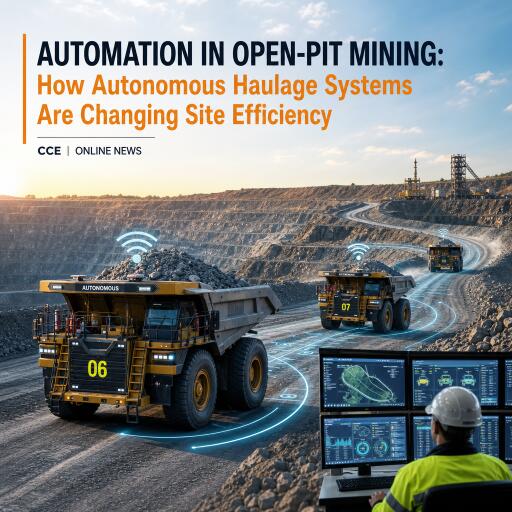

Automation in Open-Pit Mining: How Autonomous Haulage Systems Are Changing Site Efficiency – CCE l ONLINE NEWS
The modern open-pit mine is rapidly becoming a place where the biggest machines steer themselves. In iron ore, copper, gold and coal operations worldwide, ultra-class haul trucks now trace preplanned routes, avoid hazards, queue at shovels and return to dumps without a driver on board. Autonomous Haulage Systems (AHS) have shifted from curiosity to cornerstone, reshaping how pits are designed, staffed and run.
How driverless haulage actually works
Autonomous trucks rely on four tightly coupled technology layers working in real time: precision positioning, environmental sensing, onboard computation and fleet communications. For a 300-tonne truck moving at highway speeds inside an active pit, all four must be rock solid.
- Positioning: High-precision GNSS paired with inertial measurement keeps trucks located to within centimeters across vast, complex benches. Because satellite signals can be disrupted by solar activity or interference, newer designs emphasize redundant positioning and sensor fusion.
- Sensing: LiDAR systems scan the scene dozens of times per second for exact depth and contour, while 77 GHz radar cuts through dust and fog to spot obstacles. Vision systems classify light vehicles, personnel, edge erosion and rock falls. These channels run in parallel, feeding a safety stack that halts motion if anything conflicts.
- Compute: Edge processors on the truck fuse data, maintain a situational model and execute path planning and control with deterministic timing.
- Connectivity: Low-latency links tie each truck to control rooms and fleet management, coordinating routes, right-of-way and production priorities.
From one robot to a coordinated fleet
The big productivity unlock comes when dozens or even hundreds of trucks move as a synchronized network. Leading platforms—FrontRunner, MineStar Command, Hitachi’s system and a growing wave of Chinese-developed solutions—plug directly into mine-wide fleet management to orchestrate shovel-truck-dump cycles, intersection behavior, fueling, and maintenance windows. Manned and unmanned assets share the same playbook, with dispatch optimizing who goes where and when.
The business case: hours, fuel, wear and tonnage
Haulage is often 40–60% of open-pit operating cost, so even small efficiency gains pay big dividends:
- More uptime: Autonomous fleets don’t take breaks or call in sick, raising effective operating hours across the year.
- Lower fuel burn: Smooth, algorithmic driving and route selection commonly trim fuel by around 10–12%, which scales to millions annually for large fleets.
- Reduced wear: Consistent braking and cornering extend tyre and component life.
- More tonnes moved: Better queue discipline and coordinated routing raise throughput without adding trucks.
Real-world milestones underline the shift. FrontRunner sites collectively add well over six million tonnes to daily haul totals. In 2026, the 1,000th autonomous ultra-class truck joined a North American gold operation, a symbolic crossing of scale. Another major platform had nearly 700 autonomous trucks in the field by late 2024 and is targeting more than 2,000 by decade’s end, with billions of tonnes already moved. Oil sands sites in Canada run fleets measured in triple digits. In China, a smart coal project set a benchmark by operating 56 driverless trucks alongside more than 800 manned vehicles. Chinese vendors—CiDi, EACON, WAYTOUS and others—are scaling aggressively, buoyed by domestic demand and expanding into international markets. Hitachi’s approach leans into deep IoT integration, tying mobile fleets to a centralized digital mine that also spans drilling, sensing and predictive maintenance.
Africa’s inflection point
While Australia and the Americas led the first wave, African open-pit mines are increasingly in the automation conversation. South Africa’s mining sector, about 6% of nominal GDP, is already seeing workforce transitions as autonomous haulage reduces idle time and opens roles for control room operators, maintenance specialists and software-savvy technicians. Since late 2025, major mining tech firms have expanded autonomous haulage and drilling across the continent, including sizable orders for autonomous and electric blasthole drills in 2026—signals that pilots are maturing into fleet-wide rollouts.
At the Kamoa-Kakula copper complex in the DRC, precision mining and real-time monitoring underpin a push toward 500,000 tonnes of copper per year from 2028. Across Zambia and the DRC’s copper belts, West and East African gold hubs, and Guinea’s iron ore developments, the AHS value proposition is sharpened by remote locations, high logistics costs, rising labor expenses relative to output, challenging road conditions and investor pressure on safety and ESG performance.
What slows adoption
- Capital and re-engineering: Deploying AHS is not a simple truck purchase. Pits often require road redesign, added roadside infrastructure, communications upgrades, control centers and a commissioning period that can temporarily dent productivity. Paybacks of three to five years seen by majors are tougher for smaller fleets.
- Connectivity and positioning risk: Robust GNSS and reliable, low-latency networks are essential. Many remote African sites still depend on variable satellite links. Building resilient corrections and comms adds cost and complexity.
- Workforce and social license: Automation is a redeployment challenge with community implications. Meeting local content rules and proving that new technical jobs replace lost ones is vital for long-term acceptance.
- Mixed fleets: Interoperability across brands and payload classes remains limited. Retrofits are possible but often demand bespoke engineering.
Safety, carbon and the road to electric autonomy
Automation enforces ideal driving behavior—steady speeds, gentle accel/decel and smart route choices—that humans can’t match consistently. The result is documented fuel efficiency gains approaching the low teens, extended tyre and brake life, and lower Scope 1 emissions per tonne moved. As electrified drivetrains spread, autonomy pairs naturally with trolley-assist, battery-electric and hydrogen fuel cell trucks. The destination is clear: eliminate the driver and the diesel, and you maximize both efficiency and decarbonization.
Market outlook
The AHS market was roughly USD 500 million in 2024 and is projected to approach USD 900 million by 2031, a steady high-single-digit CAGR. Open-pit mining captures the lion’s share of robotics spending, reflecting the need to automate repetitive bulk movement in coal, iron ore and copper. Around 1,000 autonomous trucks were running globally in 2023, a figure expected to at least double by 2026. The heaviest classes—above 200 tonnes—dominate deployments, and fully autonomous modes are growing fastest as LiDAR, GNSS and AI fleet systems mature. North America leads installations, Australia follows, and Latin America has become the hottest growth region. Africa’s curve will hinge on infrastructure investment, policy clarity, commodity cycles and vendor models suited to local capital structures.
The next move for African miners
Autonomous open pits are no longer a forecast; they’re operating reality. The imperative now is preparedness: skills development for control-room and maintenance roles; robust connectivity and positioning plans; pit designs aligned to autonomy; and honest, early engagement with regulators and communities. Sites that build these muscles first will bank the productivity, safety and sustainability gains already visible across the world’s most automated mines.