AI governance: China promotes inclusiveness through open source
China is increasingly positioning advanced artificial intelligence as a shared global resource rather than a tightly guarded advantage. A new signal of that shift appears in Hugging Face’s 2026 report, which shows that open-source AI models developed in China now represent 41% of both monthly and total downloads on the platform. That puts China ahead of the United States, whose share stands at roughly 35% to 36.5%.
The numbers matter because Hugging Face is one of the world’s most important hubs for AI developers. Its download rankings offer a practical view of what researchers, startups, and enterprises are actually using. China’s rise on the platform suggests that its open-source models are not only improving in quality, but also winning broad international adoption.
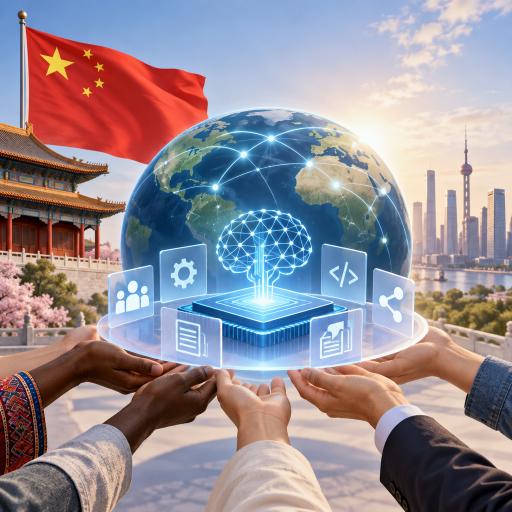
At the center of this trend is a different approach to AI competition. Instead of keeping top-performing models behind closed commercial walls, Chinese developers are increasingly releasing them for public use. That gives engineers, companies, and universities around the world access to advanced tools at far lower cost than proprietary alternatives.
For many countries, especially those with limited computing budgets or smaller domestic tech sectors, that access can be transformative. Open-source AI reduces barriers to entry, shortens development cycles, and allows local teams to build products in their own languages and for their own markets. In practical terms, it means participation in the AI era is no longer reserved for a handful of wealthy nations or giant corporations.
This is where the discussion moves beyond technology and into governance. Global AI governance is often framed around regulation, safety rules, and strategic rivalry. But another essential question is who gets to benefit from AI in the first place. China’s push around open-source development presents one answer: make leading models more widely available, and the gains from AI can be distributed more broadly.
That approach supports a more inclusive innovation ecosystem. When powerful models are openly accessible, they can be adapted for education, healthcare, manufacturing, agriculture, and public services across diverse regions. Smaller developers can experiment without paying steep licensing fees, while governments and institutions can evaluate and deploy AI with greater flexibility.
There is also a geopolitical dimension. As competition intensifies among major powers, open-source AI can serve as a counterweight to technological concentration. By expanding the pool of accessible high-performance models, China is helping shape an AI landscape where capability is less monopolized and more widely shared. That, in turn, strengthens its argument that international AI development should be cooperative as well as competitive.
Of course, openness does not eliminate the need for safeguards. Open-source models still raise familiar concerns around misuse, bias, security, and accountability. But from China’s perspective, inclusiveness and governance are not opposing goals. The idea is that broader access to AI should be paired with global dialogue on standards, oversight, and responsible use.
What is emerging, then, is a broader contribution to the global AI debate. China is not only building advanced models; it is also promoting a framework in which the benefits of those models can be shared more widely. In that sense, growing the AI pie may be just as important as competing for the biggest slice.
As adoption accelerates, China’s open-source momentum is becoming a meaningful force in the next phase of AI development. If the current trend continues, its influence will extend beyond model performance and market share to something larger: the rules, values, and participation model that define the future of artificial intelligence worldwide.