
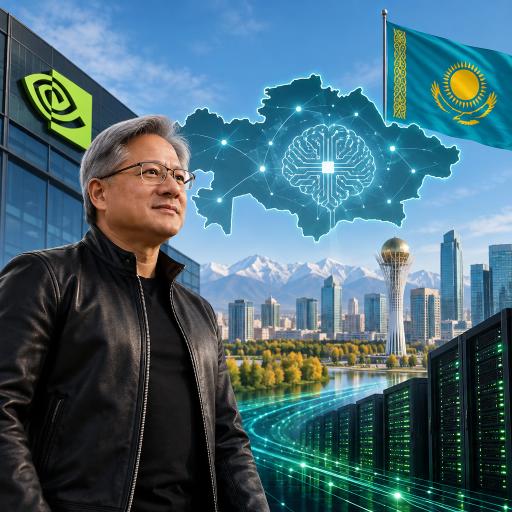
NVIDIA CEO Sees Kazakhstan as Emerging AI Hub During First Visit
NVIDIA founder and CEO Jensen Huang said Kazakhstan has the core ingredients needed to build a serious artificial intelligence industry: abundant energy, strong technical talent, and a fast-growing computing base. Speaking in Astana during his first visit to the country on Oct. 23, Huang argued that Kazakhstan is well positioned to turn those strengths into an advantage in the global AI race.
His remarks came during a fireside chat at the alem.ai International AI Center with Zhaslan Madiyev, Kazakhstan’s deputy prime minister and minister of artificial intelligence and digital development. The visit also marked the close of Kazakhstan’s AI Month, a nationwide series of events designed to showcase the country’s expanding AI ecosystem and bring together developers, researchers, tech firms, and investors.
Huang praised the speed of Kazakhstan’s progress, saying the country is moving faster than many others that are still debating how to participate in the AI economy. He highlighted the political will behind that push, noting that Kazakhstan stands out as the first country he has visited where the president has explicitly declared the ambition to become an “AI nation.”
From energy exporter to intelligence exporter
A central theme of Huang’s message was that Kazakhstan should think beyond its traditional role as an energy exporter. In his view, the country can use its natural resources to power AI infrastructure and eventually export “intelligence” rather than only raw energy.
That idea reflects a broader trend in the AI industry, where large-scale model training and inference require enormous volumes of electricity, data, and computing capacity. Huang described modern data centers as “AI factories,” arguing that countries with available energy and long-term strategic vision will have an edge in building them.
For Kazakhstan, that creates a natural opening. With substantial energy resources and growing digital infrastructure, the country could become a regional base for AI computing and services, especially if it continues expanding data center capacity and attracting global partners.
Sovereign AI and national control over data
Huang also strongly backed the idea of sovereign AI — the principle that countries should retain control over their own data and develop AI systems tailored to their language, culture, and national interests. Asked whether Kazakhstan should invest in its own large language models, he framed the issue as one of national security.
For Kazakhstan, that means building AI tools that understand the Kazakh language and local context, while ensuring that the data generated by society remains under domestic control. Huang compared data to natural resources, suggesting that a nation’s digital information should be treated as a strategic asset in much the same way as oil, gas, or minerals.
He said open-source technologies could help Kazakhstan accelerate that process, allowing local developers to build national capabilities without reinventing every layer of the AI stack. He also pointed to the country’s pool of engineers and programmers as a major advantage in developing locally relevant systems.
The next frontier: physical AI
Beyond software and chatbots, the conversation turned to what Huang called the next wave of the industry: physical AI. This includes robots and intelligent systems that interact with the real world, from industrial automation to autonomous machines in agriculture, mining, logistics, and energy.
Huang suggested Kazakhstan could play a meaningful role in this space because of its experience in resource-heavy industries. Physical AI, he said, is not limited to humanoid robots. It also includes applications such as geological exploration, seismic analysis, mineral mapping, and the optimization of industrial processes.
That matters for Kazakhstan because these are sectors where the country already has depth. Rather than simply importing foreign technologies, it could help shape how AI is applied in real industrial environments.
Backing talent and startups
The discussion also touched on NVIDIA’s investment in Higgsfield, an AI video-generation startup with a major presence in Kazakhstan and a reported valuation of $5.4 billion. Huang used the example to make a broader point: successful tech ecosystems are ultimately built by investing in people, not just companies.
He said Kazakhstan’s prospects depend on the combination of local talent, rising compute capacity, and stronger links to the global technology market. Huang dismissed fears that AI will only eliminate jobs, arguing instead that it can expand what people and businesses are capable of doing — whether in farming, engineering, science, or manufacturing.
Madiyev emphasized the same theme from a policy perspective, stressing the importance of AI education from an early age. Huang echoed that point, saying ambition will determine who benefits most from the technology. In his view, individuals, companies, and countries that think big will be best positioned to use AI as a force multiplier.
Advice for the next generation
Asked what he would do if he were 18 years old and living in Kazakhstan today, Huang gave a characteristically direct answer: he would aim to become the best AI programmer in the world.
He said young people are entering the field at a historic moment, with AI representing a technological reset on the scale of the personal computer revolution. For that reason, he argued, the next generation should focus not only on using AI tools but on understanding how they work, where they fail, and how they can be improved.
NVIDIA ties deepen in Kazakhstan
Huang’s visit coincided with new momentum around AI infrastructure in Kazakhstan. NVIDIA is set to participate in the development of the Data Center Valley project in Ekibastuz, a northeastern city that is emerging as a future computing hub.
On Oct. 23, NVIDIA said U.S.-based Firebird had signed an investment agreement with the Kazakh government and received a U.S. export license for 45,000 NVIDIA Grace Blackwell GPUs. Firebird is developing the first phase of the project together with Kazakhtelecom, the country’s largest telecom operator, with commercial operations expected to begin in the third quarter of 2027.
Kazakhtelecom has already deployed 880 NVIDIA GPUs in Astana and Almaty. By 2027, it expects to add more than 2,000 additional GPUs, including over 1,000 NVIDIA Vera Rubin processors in Ekibastuz.
Taken together, Huang’s message was clear: Kazakhstan has a rare opportunity to convert energy, talent, and political ambition into a durable AI economy. The question now is whether it can scale that momentum into lasting regional leadership.