
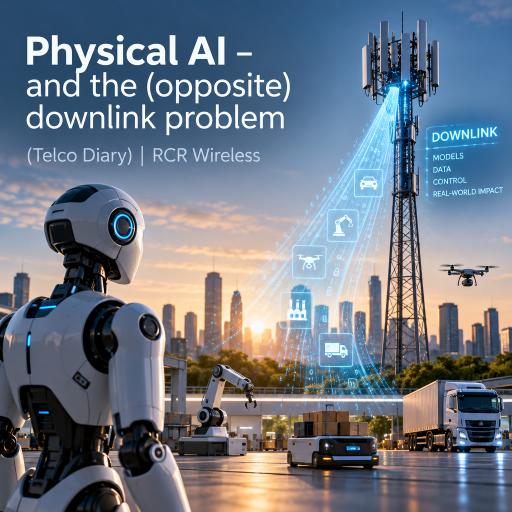
Physical AI – and the (opposite) downlink problem (Telco Diary) | RCR Wireless
Telecommunications companies are preparing for an era in which artificial intelligence moves beyond software and begins controlling robots, vehicles, drones and industrial equipment. Much of the industry’s attention has focused on the flood of information these machines will upload to cloud and edge platforms. However, physical AI is also creating a less obvious challenge: delivering the right instructions to devices at precisely the right moment.
This emerging downlink problem is not primarily about raw bandwidth. It concerns timing, operating context, network awareness and reliability. A delayed software package might be inconvenient for a smartphone, but an interrupted model update or missing command could affect how an autonomous machine behaves in the physical world.
AI-RAN advances amid a quiet infrastructure market
Nokia continues to position AI-RAN as a potential source of both network efficiency and new operator revenue. Its stated ambition is to achieve spectral-efficiency improvements of up to 100% by 2028, with live operator trials expected to begin with at least two carriers in 2026.
The company is developing the technology with Nvidia, combining radio infrastructure with accelerated computing. The idea is that operators could use shared processing resources for conventional RAN workloads while allocating spare capacity to AI applications.
This strategy arrives as the broader radio access network market remains relatively subdued. Operators are unlikely to make another major infrastructure leap until the 6G investment cycle gathers momentum. AI-RAN therefore offers vendors a possible growth opportunity before large-scale 6G deployments begin.
Questions remain about whether mobile operators are the natural providers of GPU-based edge computing. Many carriers divide their regional networks among multiple equipment vendors, potentially creating inconsistent AI capabilities. Edge processing also does not automatically eliminate every latency issue, particularly when data must still travel between a device, an AI model and an application platform.
Why physical AI changes the downlink
Traditional IoT discussions emphasize uploading sensor readings, video, telemetry and machine data. Physical AI expands the importance of traffic moving in the opposite direction. Connected machines may need new inference models, operating policies, security patches, navigation information or application-specific instructions.
Some intelligence can run directly on a device, reducing dependence on remote infrastructure. Even then, local models require periodic updates. Other applications will rely on nearby edge systems or cloud-based inference. If connectivity disappears, the result may be more serious than a temporary loss of monitoring data: the machine’s functionality could be restricted or altered.
Consider a shared electric scooter that needs a firmware or AI-model update. The best opportunity may be a short period when it is parked, inactive, sufficiently charged and connected through a strong network signal. Sending the package while the scooter is moving, in weak coverage or about to be rented could waste resources or interrupt service.
Conventional content delivery platforms do not inherently understand all these conditions. They can distribute files efficiently, but they may lack detailed knowledge about a device’s real-time location, connection quality and operational state. Mobile and IoT networks possess much of that context.
Network-aware content delivery
IoT connectivity provider FloLIVE is promoting a network-aware approach to content distribution. Instead of treating every connected machine as a generic endpoint, the network could determine when and where delivery is most likely to succeed.
Such a system could evaluate whether a device is stationary, roaming, connected through an appropriate network or operating within a permitted jurisdiction. Updates could then be scheduled around actual network and device conditions rather than sent according to a fixed timetable.
This capability also intersects with security, resilience and data-sovereignty requirements. Global physical-AI deployments may cross numerous operator territories, each with different coverage, compliance rules and infrastructure. A connectivity platform with local network visibility could coordinate delivery more consistently than a single regional carrier.
A new priority for connected machines
Physical AI will still create enormous uplink demand as cameras, sensors and robots generate increasingly complex datasets. Yet downlink performance may become just as important. The defining metric will not always be how many gigabits can reach a machine, but whether critical information arrives during the correct operational window.
For robotics, autonomous mobility and immersive industrial systems, dependable downlink delivery could become a core safety and performance requirement. The next phase of IoT networking will therefore need to understand not only where a device is connected, but also what it is doing and when it is ready to receive new intelligence.