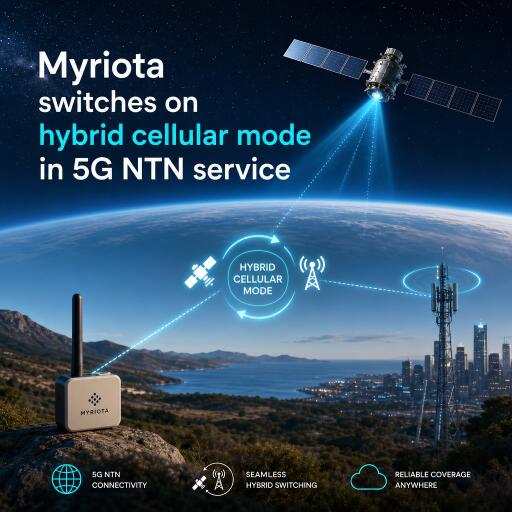

Myriota switches on hybrid cellular mode in 5G NTN service
Myriota is expanding its satellite IoT platform with a new hybrid capability that blends terrestrial cellular coverage with its existing 5G Non-Terrestrial Network (NTN) connectivity. The upgrade, rolling out later this month, enhances the company’s HyperPulse architecture and its companion asset tracker to seamlessly use either ground networks or low-power satellite links—whichever is available and most efficient.
What’s new
The HyperPulse platform—already designed around 5G NTN standards—will now integrate a cellular layer alongside its satellite link. In practice, that means devices can communicate over traditional cell networks when signals are strong and affordable, then switch to satellite when operations move out of range. The satellite path uses L-band capacity provided via Viasat, a frequency well-suited for small antennas and all-weather reliability.
Why it matters
Hybrid connectivity directly addresses the biggest limitation in wide-area IoT: patchy coverage. Assets rarely stay put, and logistics routes, agricultural fields, mining sites, and offshore operations often fall outside reliable cellular footprints. With a dual-mode design, operators gain:
- Continuity of data: terrestrial when possible, satellite when necessary
- Optimized costs: use cellular for bulk or frequent updates, satellite for critical telemetry
- Lower power draw: lean satellite messaging paired with energy-aware switching strategies
- Standardization: 5G NTN alignment helps simplify integration and future-proof deployments
How it works
HyperPulse combines an NTN-compliant stack with a terrestrial modem. An on-device decision engine evaluates signal quality, link availability, and payload needs to select the appropriate uplink each time data is sent. When terrestrial coverage is available, the device uses it to move data more frequently or at higher throughput. When coverage drops—remote highways, deserts, dense forests, mid-ocean—the device falls back to an L-band satellite channel to continue sending essential messages.
L-band’s propagation characteristics allow compact terminals to maintain reliable links with modest power budgets, a crucial factor for long-lived field sensors and trackers. The architecture is built to support low-duty-cycle transmissions and lightweight protocols, helping preserve battery life while maintaining situational awareness for critical assets.
The asset tracker angle
Alongside the platform update, Myriota’s asset tracker has been designed specifically with hybrid IoT in mind. The device is intended for deployments where assets routinely cross the boundaries of terrestrial networks—rail cars moving through rural corridors, shipping containers in port and at sea, construction equipment cycling between city centers and remote job sites. With hybrid mode enabled, tracking applications can maintain consistent positioning updates, status pings, and alerts, regardless of location.
Use cases poised to benefit
- Logistics and supply chain: end-to-end visibility from warehouse to last-mile, including dark zones between towers
- Agriculture: monitoring equipment and remote infrastructure across large properties with mixed coverage
- Energy and utilities: oversight of pipelines, metering, and remote assets where cellular access is intermittent
- Maritime and fisheries: continuity from coastal LTE to open-water satellite links
- Public sector and environmental monitoring: resilience during disasters and in wilderness deployments
Why 5G NTN matters here
By aligning with 5G NTN standards, HyperPulse positions satellite IoT within the broader 5G ecosystem rather than as a parallel silo. That standardization supports more unified device behavior, clearer roaming models between terrestrial and non-terrestrial coverage, and streamlined integration for solution providers. In short, it helps turn “satellite as last resort” into “satellite as a seamless layer.”
Power and efficiency considerations
Battery life remains the gating factor for many IoT deployments. The hybrid approach and L-band transport help strike a balance: use terrestrial networks when frequent or larger data bursts are required, then rely on compact satellite messages when connectivity gets scarce. Adaptive reporting intervals, event-driven alerts, and context-aware link selection all contribute to longer service intervals with minimal field maintenance.
Availability
The hybrid mode for HyperPulse and its associated tracker is slated to go live later this month. Organizations planning pilots or scale deployments can align rollouts to take advantage of the dual-mode architecture as it becomes available.
The bigger picture
Hybrid terrestrial-satellite designs are rapidly moving from niche to normal in IoT. As enterprises demand uninterrupted visibility and standardized connectivity, solutions that merge 5G NTN with established cellular footprints will set the pace. Myriota’s move underscores a broader industry shift: connectivity is no longer about picking one network, but about orchestrating the right one at the right moment.
Key takeaways
- Myriota is enabling a cellular layer within its 5G NTN satellite IoT stack, HyperPulse.
- The system pairs terrestrial networks with low-power satellite connectivity over L-band capacity sourced via Viasat.
- The hybrid mode supports the company’s asset tracker, built for deployments that cross in and out of coverage.
- Launch is expected later this month, bringing always-on visibility to logistics, agriculture, energy, maritime, and more.