
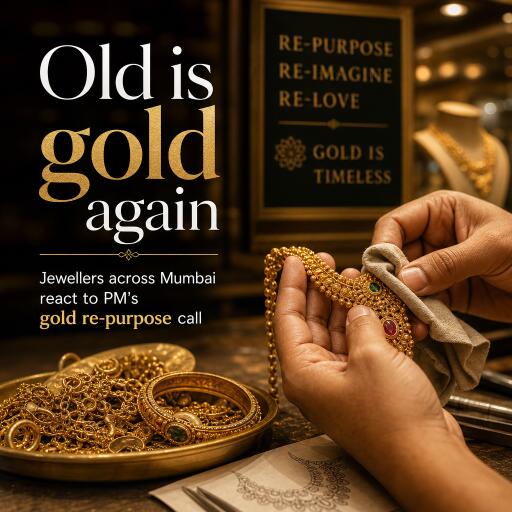

Old is gold again | Jewellers across Mumbai react to PM’s gold re-purpose call
Following the Prime Minister’s appeal to minimize fresh gold purchases, the Centre has hiked customs duty on gold and silver from 6% to 15% to curb imports and protect foreign exchange at a time of global uncertainty. The ripple effect in Mumbai’s jewellery market has been immediate: families are dusting off heirlooms and choosing to remodel them instead of buying new pieces.
For many, the shift is as emotional as it is economical. One Mumbai mother, preparing for her daughter’s November wedding, said the family will now redesign long-cherished pieces to fit modern tastes and budgets. Years ago, her ailing mother had entrusted her with a treasured nathni (nose ring), hoping the granddaughter would wear it on her big day. With prices climbing and new purchases now seen as a luxury, the family has decided to keep the heirloom nathni unchanged and update other items to suit the bride’s style. The bride, initially reluctant, is now on board—seeing it as both a practical choice and a way to carry her grandparents’ blessings down the aisle.
Redesign counters stay busy, display counters stay quiet
Across the city, jewellers report a sharp pivot from buying to repurposing. At a Dadar store, proprietor Vinod M. Parmar observed that footfall for fresh purchases has dropped dramatically compared to usual seasons, with only a small fraction of customers still considering new gold. Those who do buy are opting for very small quantities—often a token 2–3 grams—while most walk in specifically to redesign existing jewellery.
In Khar West, Prakash Takhtani of MG Sons Jewels said demand slowed further after the PM’s remarks, and the pattern is now clear: customers arrive with their old sets in hand, seeking contemporary makeovers. He explained that while stores try to soften the blow by trimming making charges where possible, remodeling heirlooms typically requires additional workmanship—disassembling, refining purity, resetting stones, and crafting new mounts—making deep discounts a challenge. Even so, jewellers are attempting to keep labour costs as reasonable as they can to support the shift.
Sentiment meets savings
For many families, retaining the soul of an heirloom carries its own premium. Jewellers say sentimental value is a key driver: clients want to preserve the history of a piece while upgrading the look for today’s wardrobes and wedding themes. Popular requests include converting chunky necklaces into lighter, multi-occasion sets; turning bangles into minimalist bracelets; and integrating heritage motifs—like old filigree or enamel work—into sleeker silhouettes.
Bridal shoppers, once inclined to purchase entirely new trousseaus, are now approaching design tables with a more modular mindset. By recasting a heavy necklace into a detachable choker and pendant, or reusing stones from legacy pieces in a modern set, families stretch budgets further without sacrificing significance. Even small gold purchases, when they happen, often serve to complement the remodeled core rather than to build a collection from scratch.
Short-term pause, long-term recalibration?
May is traditionally a softer month in the trade, but jewellers say the combination of higher duties and the public call to repurpose has amplified the lull in new sales. Still, it’s early days. Takhtani noted that it has only been a handful of days since the appeal gained traction, and the industry will need time to gauge the lasting impact. If current patterns hold, workshops specializing in redesign could remain busy, while showcases of brand-new pieces see slower movement.
For now, Mumbai’s gold story is being rewritten at the crafting bench rather than the sales counter. Families are leaning into the idea that “old is gold” not just as a saying, but as a practical response to price pressure—and a chance to give ancestral jewellery a fresh chapter. And for many brides this season, the glow of tradition, lightly reimagined, may shine brighter than anything newly minted.