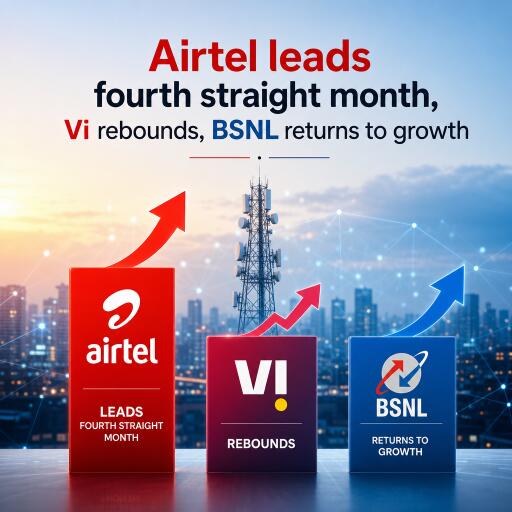

Airtel leads fourth straight month, Vi rebounds, BSNL returns to growth | Communications Today
Airtel tightened its grip on monthly momentum in July 2026, notching its fourth consecutive lead in net mobile additions. While Reliance Jio remains India’s largest carrier by a comfortable margin, the month’s tally shows Airtel steadily closing the distance. Vodafone Idea posted its strongest net adds in months, and BSNL returned to growth—though the quality of its base raises questions for planners and partners.
Wireless scoreboard: Airtel keeps the pace, Jio still on top
Airtel added 2,688,348 wireless users in July, edging Jio’s 2,446,727. That extends a run that began in April, when Airtel first pulled ahead on monthly net adds. The gap between the two narrowed in July to roughly 242,000 after being wider in June, but the sustained streak has chipped away at market-share separation.
End-July snapshots:
- Jio: 506.03 million users (39.29% share)
- Airtel: 489.49 million users (38.01% share)
- Market-share gap Jio vs. Airtel: 1.28 percentage points (down from 1.38 points in May)
Vodafone Idea (Vi) added 240,114 users in July—its best month since at least April—pushing its base to 199.06 million (15.46% share). BSNL grew by 168,874 to 93.18 million (7.23% share), logging a second straight month of gains, while MTNL shed 5,744 users. Overall, India’s wireless base expanded by 5,538,296 to 1,287.92 million.
Vi’s rebuild gathers speed
Vi’s improving trend aligns with its in-motion funding and network rollout. The operator drew ₹6,400 crore in bank financing in the June quarter, part of a three-year, ₹45,000 crore capex program. About ₹9,000 crore in orders have already been placed with major vendors, targeting roughly 3,500 new 4G sites per month across 17 priority circles over the next 18 months.
Financially, Vi narrowed its Q1 FY27 loss to ₹3,754 crore on revenue of ₹11,689 crore, up 6% year-on-year, finishing June with ₹6,558 crore in free cash and bank balances. The government’s equity conversion earlier this year lifted its stake to 48.99% from 22.60%, a structural shift that could influence capital access and long-term network ambitions.
Active users tell a different story for BSNL
Beyond headline additions, activity rates highlight a stark contrast. In July, 93.48% of India’s 1,287.92 million wireless subscribers were active—about 1,204.01 million lines. Within that, BSNL’s peak VLR (the share of subscribers actually attached to the network) was just 55.02%, far below peers: Airtel at 99.12%, Jio at 98.82%, and Vi at 83.97%. The takeaway: BSNL’s net adds may overstate real, active reach, a crucial caveat for service planning, device partnerships, and enterprise integrations.
Broadband climbs, wireline edges up
Broadband subscriptions rose to 1,094.48 million at July’s close, up from 1,087.50 million—a 0.64% monthly growth across more than 1,500 providers. Jio remained the broadband heavyweight with 520.44 million users, ahead of Airtel’s 372.94 million and Vi’s 129.95 million; BSNL contributed 22.74 million, with the rest distributed among smaller ISPs.
The total telephone base—wireless plus wireline—reached 1.354 billion, a 6.20 million increase month-on-month. Wireless accounted for 1.306 billion (+6.02 million), while wireline connections rose to 48.01 million (+190,000). In wireline, Jio led with 15.79 million connections (32.89% share), followed by Airtel at 12.15 million (25.32%), BSNL at 6.65 million (13.85%), and Vi at 760,655 (1.58%).
5G FWA stretches into rural India—good news for cloud and XR
5G fixed wireless access (FWA) kept its upward trajectory, reaching 13.21 million lines from 12.94 million in June, a gain of 272,820. It remains largely a two-horse race: Jio added 155,869 connections to 9,270,226 (around 70% share), while Airtel grew by 116,951 to 3,937,986 (about 30%). Notably, rural users now account for 50.31% of the FWA base, edging past urban at 49.69%—a telling sign that wireless last-mile is filling fiber gaps.
For gaming and XR, this is consequential. FWA can deliver the low-latency, high-throughput links needed for cloud gaming, VR multiplayer, and mixed-reality collaboration in regions where fiber deployment lags, potentially broadening the addressable audience for next-gen content and devices.
M2M momentum, with Airtel in front
Machine-to-machine connections rose to 137.70 million from 134.73 million. Airtel leads decisively with 84.45 million (61.33% share), followed by Jio at 26.56 million (19.29%), Vi at 21.92 million (15.92%), and BSNL at 4.77 million (3.46%). The enterprise-heavy nature of M2M reinforces Airtel’s strong footing in IoT and industrial deployments—an ecosystem that increasingly overlaps with connected devices, smart retail, and immersive venue tech.
Tele-density and the road ahead
Overall tele-density stood at 94.68% in July when including machine-to-machine lines, with urban density at 154.12% and rural at 61.05%. Excluding M2M, overall tele-density was 85.06%.
For consumers and creators working in gaming and virtual/augmented reality, the July readout suggests a constructive backdrop: Airtel’s acceleration, Jio’s scale, and Vi’s cautiously improving rollout all point to richer 4G and 5G coverage. With FWA spreading into rural markets and wireline continuing to add capacity, the infrastructure foundation for cloud streaming, low-latency multiplayer, and XR collaboration looks stronger than it did even a quarter ago. The remaining watch items: whether BSNL can convert dormant lines into active users, how fast Vi’s new sites translate into performance gains, and if the Airtel–Jio duel continues to lift network quality where it matters most—at the headset and controller.